
Vehicle Controls for the K53 Learner's Test: Complete Guide (2026)
Vehicle controls are the parts of a car you use to start, steer, speed up, slow down and stop it safely. Knowing what each control does is one of the three sections of the K53 learner's test. This guide explains every hand control, foot control, instrument and safety check you are tested on.
What are vehicle controls in the K53 test?
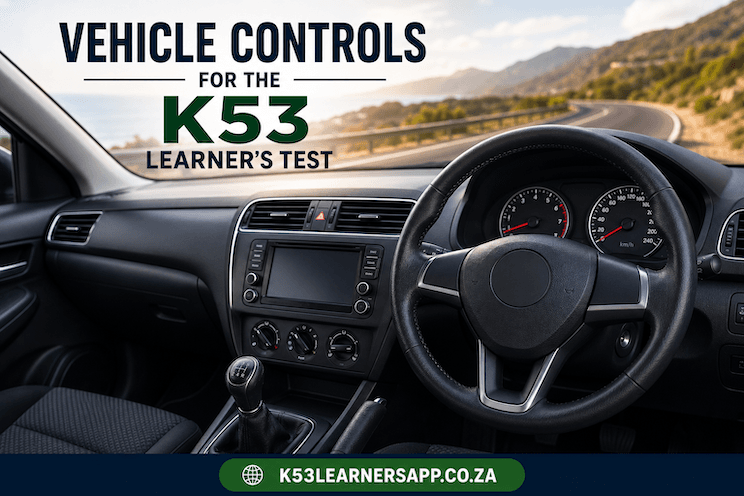
Vehicle controls are the levers, pedals, switches and instruments a driver uses to operate a vehicle. The K53 learner's test checks that you know the name and purpose of each control before you drive. The controls are grouped into hand controls, foot controls and instruments, and each one has a single, clear function.
How many vehicle control questions are in the K53 learner's test?
The vehicle controls section contains 8 questions, the smallest of the three sections. You must answer at least 6 of the 8 correctly to pass this section. The other two sections are rules of the road (30 questions) and road signs and markings (30 questions), which together make up the 68-question test. See our complete K53 guide for the full breakdown.
Practise the vehicle controls section free with our K53 learner's practice tests before your test day.
What are the hand controls of a vehicle?
Hand controls are the controls you operate with your hands. The main hand controls are:
- Steering wheel: turns the vehicle left or right. Keep both hands on it except when you change gears or signal.
- Gear lever: changes the gears to match your speed.
- Direction indicators: signal that you intend to turn left or right, or change lanes.
- Handbrake (parking brake): holds the vehicle still when it is parked, especially on a hill.
- Ignition switch: starts and stops the engine.
- Light switch: turns the headlights, bright lights and parking lights on or off.
- Hooter (horn): warns other road users of danger.
- Windscreen wiper switch: clears rain and dirt from the windscreen for a clear view.
What are the foot controls of a vehicle?
Foot controls are the three pedals you operate with your feet. From right to left they are:
- Accelerator: increases the vehicle's speed when you press it, and reduces speed when you release it.
- Foot brake: slows the vehicle down and brings it to a stop.
- Clutch: disengages the engine from the gears so you can change gear in a manual vehicle.
What do the instruments and warning lights mean?
The instruments on the dashboard show you the vehicle's speed, fuel level and engine condition. The main instruments are:
- Speedometer: shows how fast you are driving in km/h.
- Fuel gauge: shows how much petrol or diesel is left in the tank.
- Temperature gauge: warns you if the engine is overheating.
- Oil pressure warning light: warns you that the engine oil pressure is too low.
- Battery (charging) warning light: warns you that the battery is not charging.
- Rear-view and side mirrors: let you see traffic behind and beside you without turning your head.
What safety checks must you do before you drive?
Do a cockpit drill every time before you pull off. The K53 pre-drive checks are:
- Close and lock all the doors.
- Adjust your seat so you can reach all the controls.
- Adjust the rear-view and side mirrors.
- Fasten your seatbelt.
- Check that the handbrake is engaged and the gear lever is in neutral.
- Start the engine and check the fuel gauge and warning lights.


Frequently asked questions about vehicle controls
How many vehicle control questions must you answer correctly?
You must answer at least 6 of the 8 vehicle control questions correctly to pass that section.
What is the difference between hand controls and foot controls?
Hand controls, such as the steering wheel, gear lever and handbrake, are operated with your hands. Foot controls are the three pedals: the accelerator, foot brake and clutch.
What does the clutch do?
The clutch disengages the engine from the gearbox so you can change gears smoothly in a manual vehicle.
What is the handbrake used for?
The handbrake, or parking brake, keeps your vehicle stationary when it is parked, especially on a slope.