
Rules of the Road in South Africa: Complete K53 Learner's Guide (2026)
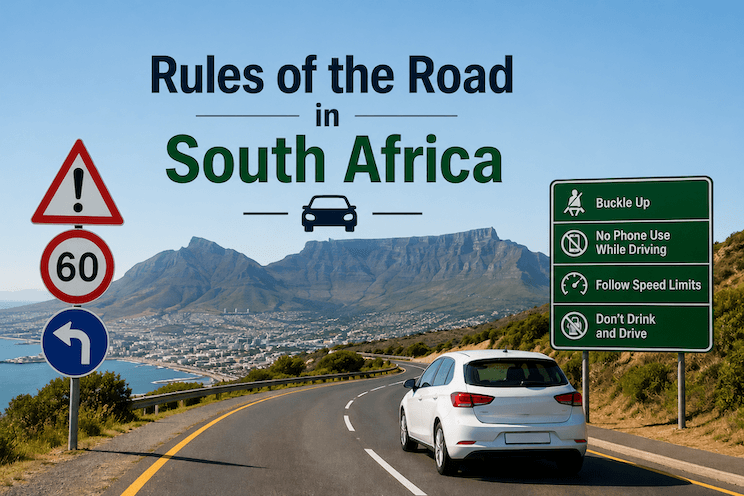
The rules of the road are the laws that control how every driver moves on a public road in South Africa. They are set by the National Road Traffic Act 93 of 1996 and form one of the three sections of the K53 learner's test. This guide covers every rule you are tested on: speed limits, right of way, following distance, overtaking, signals, pedestrians, parking and the alcohol limit.
What are the rules of the road in South Africa?
The rules of the road are the legal requirements that govern speed, position, priority and driver behaviour on public roads. They exist to keep every road user safe and predictable. In the K53 system they are applied through defensive driving: observing, signalling and keeping a safe space around your vehicle at all times. Every rule below is enforceable by law, and breaking one carries a fine and, from 1 September 2026, demerit points.
How many rules of the road questions are in the K53 learner's test?
The rules of the road section contains 30 questions, the largest of the three sections. You must answer at least 22 of the 30 correctly to pass this section. The full learner's test has 68 questions in total: 30 on rules of the road, 30 on road signs and markings, and 8 on vehicle controls. Read our complete K53 guide for the full test breakdown.
Practise the rules of the road section free with our K53 learner's practice tests before your test day.
What are the speed limits in South Africa?
South Africa has three general speed limits that apply unless a road sign shows otherwise:
| Road type | General speed limit |
| Public road in an urban area | 60 km/h |
| Public road outside an urban area (not a freeway) | 100 km/h |
| Freeway | 120 km/h |
Goods vehicles with a gross vehicle mass over 9 000 kg are limited to 80 km/h on all roads. Buses and minibus taxis may not exceed 100 km/h. A signposted limit always overrides the general limit. Parliament has proposed lowering urban limits, but that change is not yet law, so 60 km/h remains the current urban limit.
Who has right of way in South Africa?
You give right of way to traffic on your right at an uncontrolled intersection, unless a sign, road marking or traffic signal directs otherwise. The key priority rules are:
- Four-way stop: the vehicle that stops first moves off first. If two vehicles stop at the same time, the vehicle on the right goes first.
- Yield / give-way sign: you give way to all traffic on the through road before entering.
- Traffic circle: you give way to traffic already in the circle and to traffic approaching from your right.
- Pedestrians: you give way to pedestrians on a pedestrian crossing.
- Emergency vehicles: you give way to an ambulance, fire engine or police vehicle sounding a siren.
Learn the priority signs in our regulatory road signs guide.
What is the correct following distance?
Keep a following distance of at least two seconds behind the vehicle in front when driving a light motor vehicle or motorcycle. Heavy vehicles must keep at least three seconds. To measure it, watch the vehicle ahead pass a fixed point such as a pole, then count "one thousand and one, one thousand and two." Increase the gap in rain, fog, poor visibility or when another driver follows you too closely.
What are the rules for overtaking?
You overtake on the right-hand side of the vehicle in front, and only when the road ahead is clearly visible and safe. The overtaking rules are:
- Never cross a solid (barrier) line to overtake.
- Never overtake on a blind rise, a sharp curve, at an intersection or near a pedestrian crossing.
- Return to the left lane as soon as it is safe, without cutting in.
- Move to the left to let a faster vehicle pass you when it is safe to do so.
You may only pass on the left in specific cases, such as when the vehicle ahead is turning right. Road markings that control overtaking are covered in our road signs and markings section.
What are the rules for stopping, standing and parking?
Park your vehicle on the left side of the road, facing the direction of travel. You may not stop or park:
- Within 9 metres of an intersection.
- On or near a pedestrian crossing.
- On a freeway, except in a genuine emergency.
- On a solid white line or in a lane reserved for buses or taxis.
- In front of a driveway or where a sign prohibits it.
Switch on your hazard lights if you are forced to stop in an emergency.
What are the rules at a traffic circle (roundabout)?
You give way to traffic already in the circle and to traffic on your right before you enter. Signal left as you approach your exit, and keep left unless you are turning. A mini-circle follows the same rule as a four-way stop: the first vehicle to arrive proceeds first, and the vehicle on the right has priority if two arrive together. See the roundabout ahead warning sign.
What are the rules for pedestrians?
Pedestrians have right of way on a pedestrian crossing, and you must stop to let them cross. You may not drive on a sidewalk or obstruct a crossing. Watch for pedestrians at all times in urban areas, near schools and at intersections, because they are the most vulnerable road users.
When must you use your headlights and signals?
Switch on your headlights between sunset and sunrise, and whenever you cannot see a person or vehicle 150 metres ahead. Signal before you turn, change lanes or pull off, and give other road users enough time to react. Use your hooter only when it is necessary to warn another road user of danger.
What is the legal alcohol limit for driving in South Africa?
The legal blood-alcohol limit is 0.05 grams per 100 millilitres for ordinary drivers, and 0.02 grams per 100 millilitres for professional drivers. The breath-alcohol limit is 0.24 milligrams per 1 000 millilitres. The government has approved a move to a zero (0.00) alcohol limit, but that amendment is not yet in force, so 0.05 remains the current legal limit. Driving over the limit is a criminal offence.
What happens if you break the rules of the road?
Breaking a rule of the road carries a fine, and from 1 September 2026 it also adds demerit points to your licence under the AARTO system. When you reach 15 demerit points, your licence is suspended for three months. Serious offences such as drunk driving can lead to arrest and a criminal record. Learn how the fine process works in our traffic fines guide.


Frequently asked questions about the rules of the road
What are the three sections of the K53 learner's test?
The K53 learner's test has three sections: rules of the road (30 questions), road signs and markings (30 questions), and vehicle controls (8 questions).
How many rules of the road questions must you answer correctly?
You must answer at least 22 of the 30 rules of the road questions correctly to pass that section.
What is the general speed limit in a town in South Africa?
The general speed limit in an urban area is 60 km/h, unless a road sign shows a different limit.
What is the two-second rule?
The two-second rule is the minimum safe following distance for a light vehicle: stay at least two seconds behind the vehicle in front, and more in bad weather.
Who has right of way at a four-way stop?
The vehicle that stops first goes first. If two vehicles stop at the same time, the vehicle on the right has right of way.